
- The session featured testimonials on the opportunities offered by the digital economy, the investment being made and inequality in this sector.
- A total of 4 speakers took part in this conference.
28/06/2023, Brussels. Yesterday, Monday 26 June from 10:00 to 12:30 (CEST), the third of the five days of the online seminar organised by the 100 Women Plus project was held. Today’s session, entitled «Opportunities of the digital economy», focused on the opportunities offered by the current commitment to digital tools, the existing gender gap in this field and the opportunities it offers to fight inequality. The session was attended by 4 speakers who analysed the investment being made in the digital economy and presented various initiatives aimed at reducing the aforementioned gap.
Carla García, head of European projects at Finnova, opened the session with a speech on the European Union’s digital strategy. The adaptation of European society to the digital era is one of the Commission’s priorities for the period 2019-2024, and is based on three principles: putting technology at the service of citizens, establishing a fair and competitive digital economy and advocating a more open, democratic and sustainable European society. «All these tools will enrich and improve the daily lives of Europeans», García praised the proposal and presented the «2030 Digital Europe» initiative, which is part of this adaptation to the digital era and has one objective: to empower businesses and society for a sustainable, more prosperous and people-centred digital future.
One of the challenges to be addressed within the different initiatives presented, which are supported by the European Commission, focuses on empowering women to play a more active role in the digital age. In this case, the low inclusion and participation of women in STEM careers and the gender bias in the media and the online and offline worlds are highlighted, so three areas of action are proposed: promoting digital education, tackling gender stereotypes and encouraging female entrepreneurship.
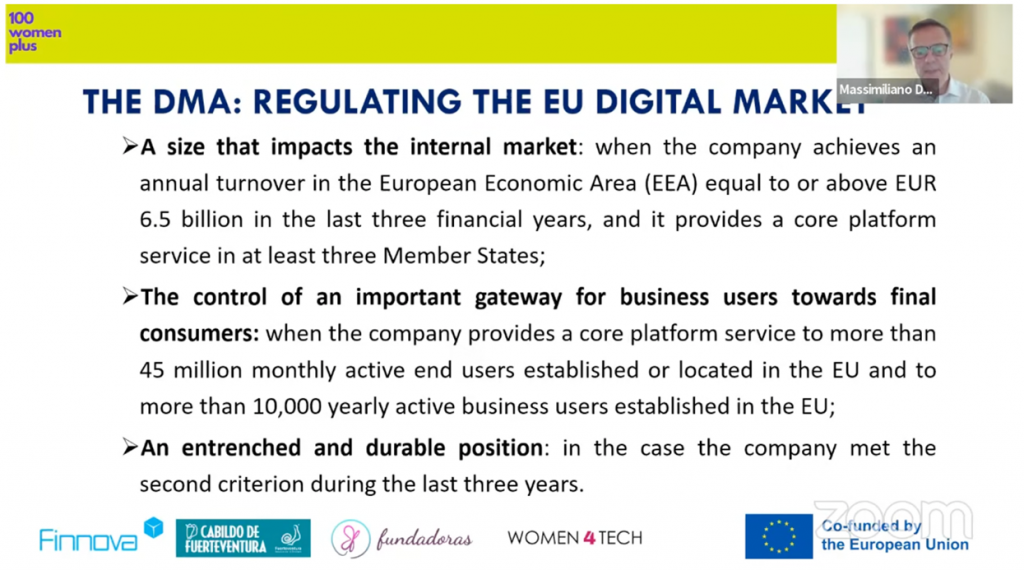
The next speaker was Massimiliano Dragoni, policy officer at the European Commission’s Directorate-General for Communication Networks. Dragoni outlined the Digital Services Act (DSA) and the Digital Markets Act (DMA), Commission proposals approved in October 2022 to create a safer digital space and establish a level playing field to foster innovation, growth and competitiveness. The DSA involves improved mechanisms for the removal of illegal content, to be accompanied by the protection of fundamental rights for users, and online platforms will have to implement these measures by February next year. For its part, the DMA aims to ensure the good conduct of large platforms in an attempt to guarantee a fair online ecosystem for businesses and users, and those platforms will have until March 2024 to implement the measures proposed by the Commission.
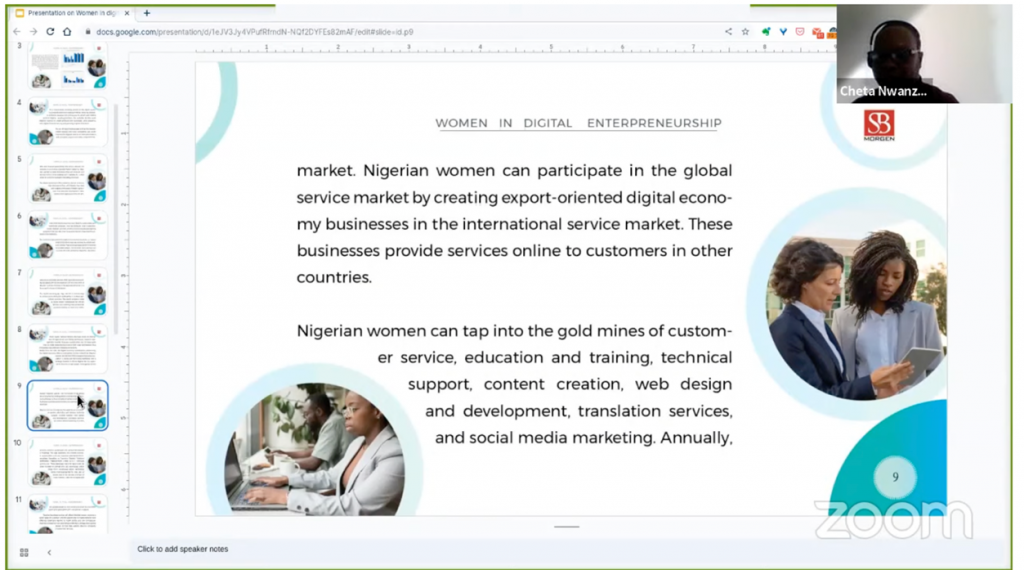
Cheta Nwanze, lead partner at SBM Intelligence, explained the opportunities for women in digital entrepreneurship, focusing on the case of Nigeria. This is a country where the gender gap is notable in aspects such as literacy and access to education, which means that this gap persists in other areas, such as economics (more than half of Nigerian women live below the poverty line). For this reason, Nwanze believes that greater inclusion of women in the digital economy «is a great opportunity to reduce inequality, as well as being the solution to the country’s economic problems». In this case, he gave the example of agriculture, a sector that represents 25% of the country’s GDP and in which 60% of Nigerian women work. «The situation of this sector, and therefore of the national economy, could improve considerably if productivity is increased by applying digital tools to agricultural practices,» she concluded.
Carla García took the floor again, focusing on the weight that proposals related to the digital economy have in the EU budget. Within the COVID-19 Next Generation pandemic recovery funds, the digital economy accounts for 20% of the total, an area that also plays an important role in other programmes such as Digital Europe, Erasmus Plus, Horizon Europe and Single Market. Beyond these plans, García brought to light examples of initiatives such as WeGate, a European platform for women entrepreneurs, the Equals network, which promotes women’s access to technology, and the Women Angels for STEAM network, a community of women who want to expand the role of women entrepreneurs in the STEAM field.
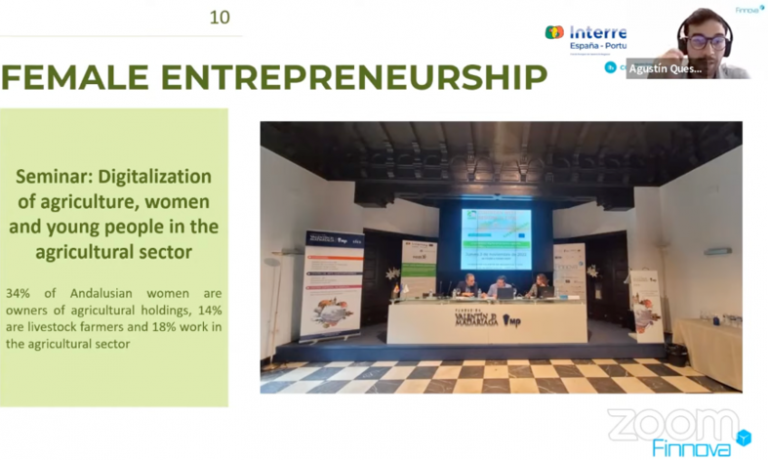
The last speech of the day was given by Agustín Quesada, head of European projects at Finnova, who presented the main conclusions of the HIBA-HUB Iberia Agrotech project. The project covers the border between Spain and Portugal, an area at risk of depopulation and with limited technological resources, so the project has contributed to the deployment of the aforementioned resources, the development of workshops for the use of these services and the adaptation of innovations to the agri-food ecosystem. Within the activities related to the project, Finnova organised the seminar «Digitalisation of agriculture, women and young people in the agricultural sector», with a panel of experts in female entrepreneurship from the Portuguese-Spanish cross-border area.
This was the summary of the third day of the 100 Women Plus webinar. Through the following link, it is possible to watch the event in its entirety: https://www.youtube.com/watch?v=pdUxitDchdg&ab_channel=FINNOVA
Today, Tuesday 27 June from 10:00 (CEST), the fourth and penultimate day of the seminars will focus on the opportunities of the green and sustainable economy. If you would like to attend the event online, you can register via the following link: https://www.eventbrite.es/e/entradas-webinar-100-women-plusopportunities-for-green-and-digital-entrepreneurship-652622099267?aff=ebdssbdestsearch
About the 100 Women Plus project:
This project, co-funded by the EU Erasmus + Programme and led by Finnova, in collaboration with the Cabildo of Fuerteventura and the association Fundadoras, was born in an attempt to address the need for greater equality and to enhance international cooperation in the field of women’s empowerment. 100 Women Plus has been designed to improve the channels of collaboration and dialogue, propose a series of learning activities, exchange of experiences and transfer of results that contribute to establishing new mechanisms for female participation, strengthen the ecosystem of women entrepreneurs in the participating countries and create networks and generate alliances between institutions in Europe and Africa.
About the Finnova Foundation:
Finnova is the Spanish-Belgian non-profit foundation based in Brussels and Spain, working for the promotion and development of innovation and entrepreneurship in the EU. Finnova’s experience in leading communication and dissemination activities for European projects is combined with a proven track record in business creation and entrepreneurship support programmes, such as accelerators, incubators and events, as well as its commitment to training and employability of young people.